
Three ingredients.
One simpler
routine.
Explore the science behind creatine, electrolytes, and collagen—and how HYPR brings them together in one scoop.

One scoop.
Three distinct roles.
A simpler routine starts with understanding what each ingredient actually does.
Energy for
your next effort.
Creatine is a naturally occurring compound stored mainly in muscle. As phosphocreatine, it helps regenerate ATP—the immediate energy source for muscle contraction during brief, intense activity. [1]
Supplementation can increase muscle creatine stores and improve high-intensity exercise capacity and training adaptations when paired with resistance training. [1]
Build a consistent habit. Creatine is about muscle stores over time, not an instant stimulant effect. [1]
Go deeper into the research
The ISSN describes daily maintenance protocols commonly using 3–5 g creatine monohydrate. HYPR provides 5 g per scoop. Loading is optional; lower daily doses build stores more gradually. Outcomes depend on training and individual response. [1]
This supports consistent use; it does not establish a perfect clock time for the finished HYPR blend.
Simplified reaction: PCr + ADP ⇌ Cr + ATP (via creatine kinase).
Schematic, not a personalized hydration prescription.
Hydration is
a balancing act.
Sweat removes water and electrolytes, particularly sodium. Replacement needs depend on exercise duration, heat, sweat rate and what you eat and drink. [2]
SodiumHelps maintain extracellular fluid balance and replaces a major electrolyte lost in sweat. [2]
PotassiumSupports intracellular fluid balance and nerve transmission. [6]
MagnesiumContributes to energy metabolism and normal muscle and nerve function. [5]
Go deeper into the research
Electrolyte replacement may be useful during prolonged or very sweaty exercise. For ordinary daily activity, food and water may be sufficient. Avoid both under-replacement and excessive drinking. [2]
Pink Himalayan salt is a sodium source; its origin alone does not establish superior hydration. HYPR’s 810 mg sodium per scoop should fit your total intake and sweat losses.
Building blocks.
An evolving science.
Collagen peptides are digested into smaller peptides and amino acids. Research has explored their use alongside exercise for joint-related outcomes and connective tissue adaptations. [3]
Some trials report benefits, but results vary. A 2024 meta-analysis found very low certainty for tendon morphology and low certainty for several other outcomes. Promising does not mean guaranteed. [4]
Collagen is not a complete protein. It complements—not replaces—adequate complete protein in your diet. [3]
Go deeper into the research
The 2021 review discussed protocols including 5–15 g per day, often over months with exercise. HYPR’s 5 g is at the lower end of that range. Different collagen types, populations and protocols make direct comparisons imperfect. [3]
These findings do not establish injury prevention or clinical efficacy of HYPR itself.
Amino acids are not sent exclusively to joints or tendons.
Different roles.
One daily habit.
The benefit of bringing them together is simple: fewer products to manage and one mixing step.
Less to manage
One product instead of three separate containers.
One mixing step
One scoop mixed into water, following the label.
Fits your routine
An easy addition to a habit you already have.
The ingredient studies below do not show that HYPR increases absorption or outperforms equivalent ingredients taken separately. No finished-formula clinical trial is presented here.
| Ingredient | Main role | Evidence-supported use | Important limitation |
|---|---|---|---|
| Creatine | Muscle energy | High-intensity performance with training [1] | Response varies; consistent intake matters. |
| Electrolytes | Fluid balance | Replacement during meaningful sweat losses [2] | Extra electrolytes are not necessary for everyone. |
| Collagen | Amino acid source | Some joint-related outcomes with exercise [3] | Evidence and protocols vary; incomplete protein. |
Know your scoop.
Clear amounts. Clearly listed.
30 servings · 16.7 g (approximately 1 scoop)
Amounts transcribed from the label shown on HYPR’s current product page. Always check the label on your container.
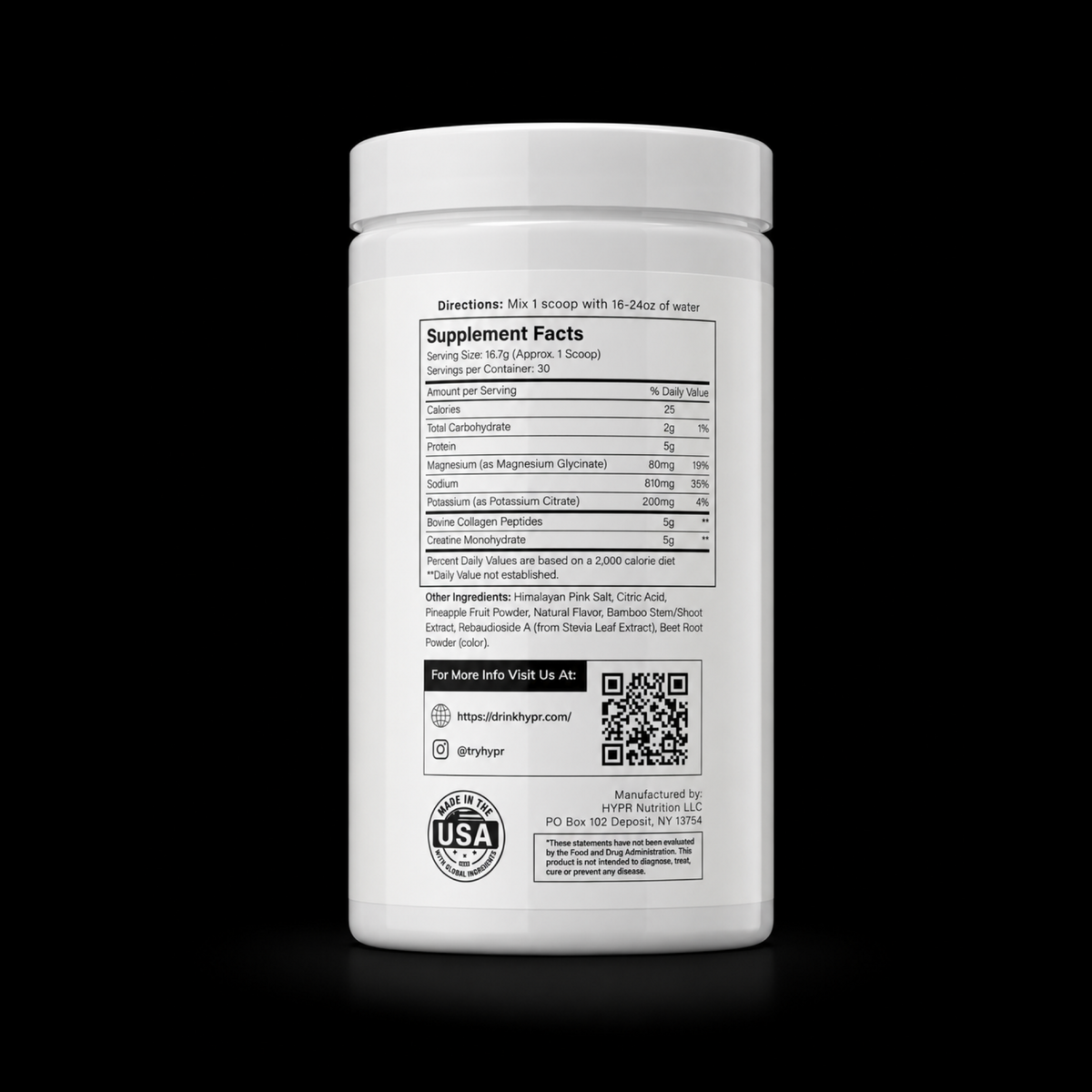
Keep the routine simple.
Scoop
Measure one scoop, following your container’s label.
Mix
Mix with 16–24 oz of water. Stir or shake.
Plan
At one serving a day, 30 servings lasts 30 days. Match replenishment to your actual use.
A little more clarity.
Understand the ingredients.
Make the routine your own.
Why are these ingredients combined?
They address different parts of a supplement routine. Combining them reduces the separate products and mixing steps you need to manage.
Does combining them make them work better?
No direct evidence reviewed here establishes that this HYPR blend works better than equivalent ingredients taken separately. The clear benefit is convenience, not proven biological synergy.
Do I need electrolytes every day?
Not necessarily. Food supplies electrolytes, and ordinary activities may not require a supplement. Long, hot or sweaty sessions can increase replacement needs. HYPR contains 810 mg sodium per scoop; account for your diet and individual needs.
Is collagen the same as protein powder?
Collagen is protein, but it is not a complete protein and is not equivalent to whey or another complete protein source for muscle building. Use it alongside adequate dietary protein.
When should I take HYPR?
Follow the label: mix one scoop with 16–24 oz of water. Choose a time that fits your routine. Creatine research focuses on building and maintaining muscle stores through repeated use; it does not establish a universal perfect time for this blend.
Where can I read the research?
Follow the numbered links alongside the science explanations, or explore the full references below. They describe ingredient research, not clinical testing of the finished HYPR formula.
Make your
routine simpler.
Creatine, electrolytes, and collagen.
Together in HYPR Watermelon.
The research, open to you.
Ingredient research is not the same as testing the finished product.
-
01Creatine supplementation: safety and efficacy ↗
Kreider RB et al. Journal of the International Society of Sports Nutrition. 2017;14:18.
ISSN position stand on muscle creatine, high-intensity exercise and supplementation protocols. -
02Exercise and fluid replacement ↗
Sawka MN et al. Medicine & Science in Sports & Exercise. 2007;39(2):377–390.
ACSM position stand on individualized fluid and electrolyte replacement during exercise. -
03Collagen peptides and exercise: a systematic review ↗
Khatri M et al. Amino Acids. 2021;53:1493–1506.
Reviews collagen protocols, joint-related outcomes and limitations of the available trials. -
04Collagen peptides with long-term physical training ↗
Bischof K et al. Sports Medicine. 2024;54:2865–2888.
Meta-analysis of 19 studies; certainty differs by outcome and is very low for tendon morphology. -
05Magnesium: health professional fact sheet ↗
NIH Office of Dietary Supplements. Online reference; accessed October 6, 2026.
Explains magnesium’s role in energy metabolism and normal muscle and nerve function. -
06Potassium: health professional fact sheet ↗
NIH Office of Dietary Supplements. Online reference; accessed October 6, 2026.
Explains potassium’s role in intracellular fluid balance and nerve transmission.